
How to Get Marion County Court Records
Begin at the case level. A Marion County court records request goes nowhere without the right office. You need to know which one holds the file. The Marion County District Clerk keeps the papers for the 115th and 276th Judicial District Courts. Criminal, civil, family, and juvenile district matters all sit there. The County Clerk holds Constitutional County Court criminal and probate material. JP1, JP2, and Jefferson Municipal Court keep their own lower-court records. A cause number is the best key. Without one, bring a full party name, an approximate date, the court, and a document title.
Online, re:SearchTX covers participating Texas courts. Treat it as one channel, not a guarantee. Nothing there? Call the District Clerk at (903) 665-2441. The County Clerk is at (903) 665-3971. District requests can be mailed to P.O. Box 628, Jefferson, TX 75657. You can also make them in person in Room 303 at 102 W Austin. County-court and probate requests go to Room 206. Ask whether a counter terminal is available before you count on it.
- Identify the court and obtain the cause number if possible.
- Check re:SearchTX for a public case entry or document.
- Call the correct clerk to confirm custody, access, fee, and copy type.
- Visit the counter or send a focused written request by an accepted route.
- State whether a plain, certified, or electronic copy is needed.
Case files are judicial records. The Texas Public Information Act does not automatically control them. Send your request to the office that holds the file, under the court-record rule. Describe a record that already exists. The clerk does not have to build a custom report or offer legal analysis.
Marion County Docket or Document
A docket and the paper behind it answer different questions. The docket is a dated register of events. It can show a filing without showing the document. A petition, motion, order, judgment, or notice may appear as an entry. The image itself stays unseen. The filed document holds the full text the clerk accepted. The gap matters in Marion County. Official pages post office contacts and fee rules, but no online viewer for trial documents.
| Item | What it provides | Best route |
|---|---|---|
| Docket history | Chronology, settings, filings, and disposition entries | re:SearchTX or court clerk |
| Filed document | Petition, motion, order, judgment, or other paper | Exact request to its keeper |
| Certified copy | Copy bearing the clerk's certification and seal | Clerk request with fees confirmed |
A free docket entry does not make the image free or public. A blank portal result proves nothing either. The court may not take part, data may lag, or the record may be restricted. Confirm with the clerk who keeps the case.
Types of Marion County Court Records
District files can run from initiating pleadings to criminal charging instruments. Answers, motions, notices, service returns, signed orders, judgments, and appeal notices fit there too. County Court files center on Marion County probate and general criminal jurisdiction. Justice courts keep their own traffic, fine-only Class C, small-claims, and eviction files. Jefferson Municipal Court holds Jefferson ordinance and municipal Class C records. The split matters here. The County Clerk and District Clerk are not interchangeable.
Family and juvenile cases are filed in District Court. Public access to their contents is limited, though. An open caption or event does not unlock every document. For older cases, name the court and a rough year first. Older files may sit on paper, microfilm, or an archived system. One caution applies. The County Clerk's online real-property records back to 1955 say nothing about court files. They cannot stand in for a civil docket.
Marion County District Clerk Route
The official page names Susan Anderson as District Clerk. Her office is Room 303 at 102 W Austin, Jefferson. Mail goes to P.O. Box 628, Jefferson, TX 75657. This office is the district-record hub for both multi-county District Courts. OCA lists NetData as its case-management system. That backend name is not a public search address.
The official District Clerk source supplies the contact path, hours, cost notices, and an expunction information boundary.
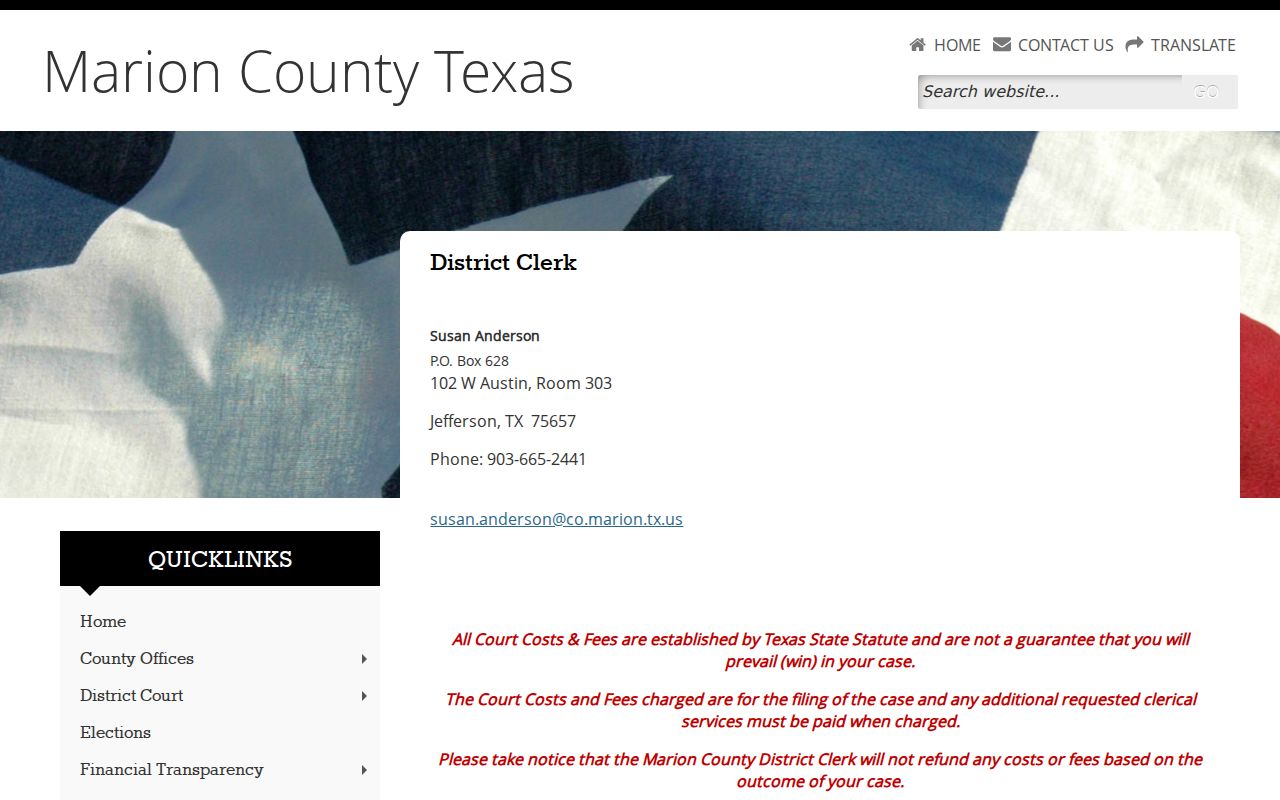
Use the live clerk page for current office details. When you contact staff, name the district court, the cause number, and the exact document you want.
What a Marion County Court Record Contains
Contents depend on the court and the case. A record ties identifying fields to dated filings and judicial acts. Marion County has no published abbreviation codebook. When shorthand confuses you, the clerk can confirm it; guesswork cannot.
| Cause number | The court's identifier and most precise request key. |
|---|---|
| Case style | The caption naming parties or the State and accused. |
| Court and judge | The assigned tribunal and officer where shown. |
| Case events | Dated filings, returns, settings, orders, and entries. |
| Disposition | An outcome label or judgment date when public. |
| Filed images | Documents linked when access and system permit. |
A docket status is not a legal explanation. "Reset" only means a setting moved, not that the case was dismissed. "Restricted" signals limited access and nothing more. When a label alone will not answer your question, ask for the public order or judgment.
Writing a Marion County Records Request
Marion County publishes no standard docket-copy request form. You can still cut search time with a clear written request. Include your name and contact information, the court, and the cause number. Add the document title and the approximate filing date. Say whether you want a plain or certified copy. Before sending anything sensitive, ask about delivery, payment, identification, and authorization. Treat these as suggested details, not fields lifted from a Marion County form.
Some district records survive only on microfilm or electronic media. Government Code section 51.3195 lets a district clerk provide a preserved motion, order, pleading, or other paper. It works on a party's written request. Archives differ, so confirm the method. The clerk posts no current payment methods, mail rules, certified-copy turnaround, or local response time. Ask first.
Certified Marion County Copies and Fees
Official copies need certification. A plain District Clerk copy runs $1 per printed page. Certification and seal add $5 on top of the page charge. An electronic document costs $1 through ten pages, then $0.10 for each added page. A search can cost $5. That applies to one without a cause number, or one to determine whether an instrument exists. An appeal record runs $1 per page, and bond approval costs $5. An abstract of judgment is $8. Ask which charges fit your Marion County copy.
| District Clerk item | Published amount | Source |
|---|---|---|
| Plain copy | $1 per page | Government Code §51.319 |
| Certified copy | $5 plus $1 per page | Government Code §51.319 |
| Electronic document | $1 through 10 pages; $0.10 each added page | Government Code §51.319 |
| Search without cause number | $5 when applicable | Government Code §51.3033 |
| re:SearchTX document | $0.10 per page, $1 minimum | OCA FAQ; verify live |
The County Clerk's posted schedule lists $1 per page, a $5 certificate, and a $5 miscellaneous search. Its header carries stale clerk information. Confirm each charge with Kim Wise's office before paying. No official source sets a universal waiver, card rule, delivery charge, or turnaround promise.
Marion County Judicial Access Rules
The Texas Office of Court Administration policy draws the line between judicial records and ordinary agency records. The official policy page spells out that distinction.
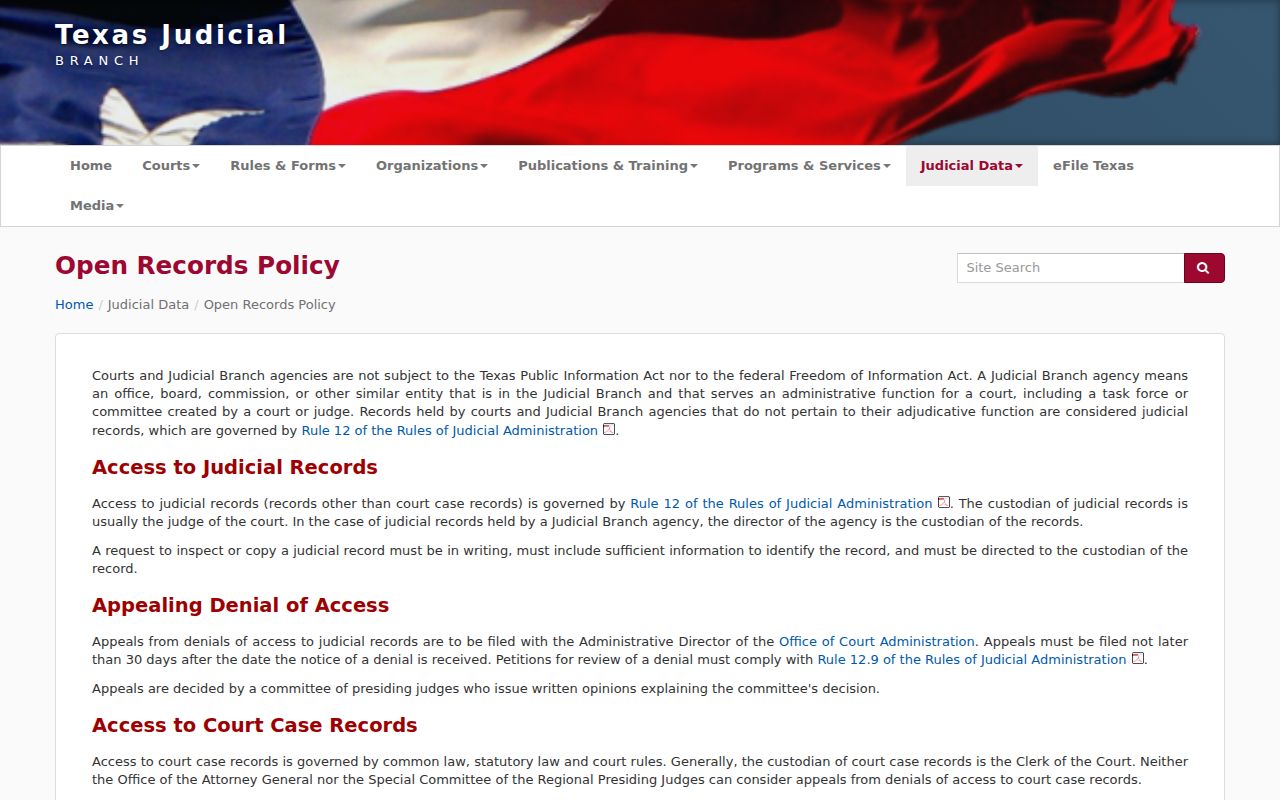
That policy favors requests addressed to the custodian. Those requests need enough detail to identify an existing record. It also blocks a wrong assumption. Not every case-file request follows executive-agency deadlines under the Texas Public Information Act. Rule 12 generally opens covered judicial records during business hours, subject to exceptions. Rule 76a presumes access but sets a court process for sealing. Rule 21c requires sensitive identifiers to be redacted. Family Code Chapter 58 restricts juvenile records. Chapter 55A governs expunction. These limits can reach a document even when part of its docket entry stays visible.
Public Access and Sealed Marion County Records
Public access does not reach every line and image. A sealing order, juvenile rule, expunction, protective order, or sensitive-data rule can withhold all or part of a Marion County record. Blacked-out fields are routine. Common redactions cover Social Security and tax numbers, account data, birth dates, home addresses, license or passport numbers, and a minor's name where Rule 21c applies.
Key Texas rules: Rule of Judicial Administration 12 governs covered judicial records. Rule of Civil Procedure 76a governs sealing. Rule 21c requires sensitive-data redaction, while Family Code Chapter 58 limits juvenile access.
A missing result is not always a dead end. Ask whether a public docket or redacted copy exists. Never use private identifiers to dodge a limit. The clerk can confirm the lawful route but cannot give legal advice or create a new analysis.
Marion County District Clerk
102 W Austin, Room 303
Jefferson, TX 75657
(903) 665-2441
Marion County Records Without a Cause Number
A missing cause number slows a Marion County court records request. Staff must determine whether an instrument exists, which can trigger the statutory $5 search charge. Give them the full known party name. Include the likely court, the case type, and the approximate filing year. Say which paper or event you need. Skip private identifiers as a shortcut. When a common name matches more than one possible case, the court and date range sort them apart. Staff can confirm the keeper and the fee before work begins. This approach helps when re:SearchTX is unavailable. It also works when an older file sits in an archive.